Contractor License Guide 2026: Requirements, Exams, Costs & How to Get Licensed by State
Whether you need a contractor license depends entirely on which state you work in and what type of work you do. About 33 states require a statewide general contractor license; the rest leave it to local governments. In states that require one, you will almost always need to pass two exams—a trade exam and a business and law exam—demonstrate 2–4 years of experience, carry a surety bond, and provide proof of insurance.
Table of Contents
What is a contractor license?
A government-issued credential that authorizes an individual or business entity to legally perform construction, alteration, repair, or demolition work within a specific state. It is issued by a state licensing board—often called a Contractors Licensing Board, a Registrar of Contractors, or a Department of Labor and Regulation—and is separate from a local business license. A contractor license is state-specific and does not automatically transfer to other states.
The terms “licensed,” “registered,” and “certified” are sometimes used interchangeably in the trade but they are legally distinct in many states. Licensed contractors have passed exams and meet full state requirements. Registered contractors have filed paperwork and may hold a bond but may not have passed a qualifying exam. Certified contractors in states like Florida hold statewide authority, while registered contractors are limited to the jurisdiction of a local government. Always verify the exact credential required in your state before applying.
Do you need a contractor license?
| State | Licensing threshold | Governing board | NASCLA accepted |
|---|---|---|---|
| Nevada | $1,000 (labor + materials) | Nevada State Contractors Board (NSCB) | Yes |
| Arizona | $1,000 (labor + materials) | AZ Registrar of Contractors (ROC) | Yes (KB-1, KB-2) |
| California | $1,000 (as of Jan 2025) | Contractors State License Board (CSLB) | No (own exam) |
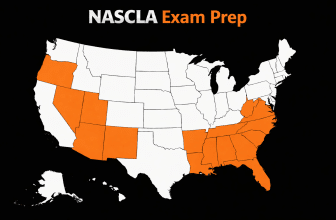
| Florida | License required before bidding — no dollar threshold | CILB / DBPR | NASCLA trade exam only |
| Georgia | $2,500 | GA State Licensing Board | Yes |
| South Carolina (commercial) | $5,000 | Contractors Licensing Board (CLB) | Yes (Groups 4 & 5) |
| South Carolina (residential) | $5,000 | Residential Builders Commission (RBC) | Yes |
| Louisiana (commercial) | $50,000 | LSLBC | Yes (commercial building) |
| Louisiana (residential) | $75,000 new construction | LSLBC | No |
| Louisiana (HIC registration) | $7,500–$74,999 remodeling | LSLBC | No |
| Alabama | $100,000 | AL Licensing Board for GCs | Yes |
| Tennessee | $25,000 | TN Contractors Licensing Board | Yes |
| Mississippi | $50,000 (commercial) | MSBOC | Yes |
| North Carolina | $30,000 | NC Licensing Board for GCs | Yes |
| Oregon | Any work requiring a permit | Construction Contractors Board (CCB) | No |
| Texas | No statewide GC license | N/A — local jurisdictions only | N/A |
| New York | No statewide GC license | N/A — local jurisdictions only | N/A |
States with no statewide general contractor license requirement
Approximately 17 states have no statewide general contractor license requirement as of 2026. This does not mean contractors in these states operate without any oversight—it means regulation falls to cities and counties rather than the state government. Texas, despite being the largest construction market in the United States, has no statewide GC license. But Houston, Austin, Dallas, and San Antonio each have their own registration requirements that contractors must meet before working in those cities.
| Colorado | Delaware | Idaho (private work) |
| Illinois | Indiana | Iowa |
| Kansas | Kentucky | Maine |
| Missouri | Nebraska | New Hampshire |
| New York | Ohio | Oklahoma |
| South Dakota | Wyoming | Texas (GC only) |
Types of contractor licenses
Residential contractor
Covers single-family homes, duplexes, and small multi-family structures. Usually has lower financial requirements than commercial. Examples: Louisiana Residential ($75K+), South Carolina RBC, Arizona B General Residential.
Commercial / General building
Covers commercial structures, industrial buildings, and multi-family high-rises. Higher financial requirements. Examples: California Class B General Building, Nevada B-General, and Louisiana Commercial Building ($50K+).
Dual license
Covers both residential and commercial work in one credential. More efficient than holding two separate licenses. Examples: Arizona KB-1 (B-1 + B combined) and South Carolina CLB Group 4/5, which covers both sectors.
Specialty / Trade contractor
Covers a single trade: electrical, plumbing, HVAC, roofing, masonry, carpentry, etc. Triggered at a lower project threshold than GC licenses in most states. A GC license alone does not authorize self-performing specialty work.
Unlimited vs limited classifications
Several states further divide their licenses by financial capacity. South Carolina uses a five-group system for commercial licenses, where Groups 1–3 cap the maximum contract value at specific thresholds and Group 5 is unlimited. North Carolina uses “Unlimited,” “Intermediate,” and “Limited” designations. Your financial statement—specifically your net worth and working capital—determines which tier you qualify for, which in turn determines the size of projects you can bid on.
What you need to qualify:
Experience
2–4 years in the classification
Financial statement
CPA-prepared, $10K–$50K net worth
Workers’ comp
Required if you have employees
Experience window
Must be within the past 5–10 years
Surety bond
$5K–$100K depending on state and tier
Background check
Required in most states
Documentation
Notarized work experience affidavit
GL insurance
$100K–$1M minimum (most states)
Experience requirements in detail
Every licensing state requires the qualifying party to document real-world experience in the classification they are applying for. The typical requirement is four years within the past ten years (Nevada, California, Arizona) or two years within the past five years (South Carolina, Louisiana). Most states require documentation through notarized letters from past employers, clients, or supervisors that describe the specific work performed — a general job title alone is not sufficient.
The qualifying party does not have to be the business owner. In most states, a licensed business can designate an experienced employee as the qualifying party on its license. South Carolina calls this the Primary Qualifying Party (PQP). Louisiana uses the same term. Nevada refers simply to the qualifying individual. If the qualifying party leaves the company, the license becomes inactive until a replacement qualifier is approved by the board.
Financial requirements
A financial statement is required in almost every state that issues contractor licenses. The statement must be current — usually within 12 months of the application date — and in most cases must be prepared by an independent CPA, bookkeeper, or accountant. Net worth minimums start at $10,000 in Louisiana and Nevada and scale upward based on the license group or classification. For contractors who cannot meet the net worth minimum, most states allow a surety bond or irrevocable letter of credit to substitute for the difference.
Surety bond requirements by state tier
| State | Bond amount range | Notes |
|---|---|---|
| Nevada | $1,000–$500,000 | Scaled by license type, monetary limit, and financial profile |
| Arizona | $5,000–$100,000 | Commercial: scaled by gross annual work volume |
| Arizona (residential) | $7,000–$15,000 | $7K under $750K volume, $15K above |
| South Carolina (residential) | $15,000 | Fixed for RBC residential builder license |
| Louisiana | $10,000 | Bond substitutes for net worth requirement if needed |
| California | $25,000 | Standard bond for all CSLB licenses |
| Washington State | $30,000 | Standard for general contractors |
| Oregon | $15,000–$25,000 | $15K residential, $25K commercial |
How to get a contractor license — step by step
The licensing process differs in sequence between states — some require board pre-approval before scheduling exams, others let you test first and then apply. The sequence below reflects the most common order.
Determine your license classification
Identify whether you need a residential, commercial, dual, or specialty license, and — in states with group systems — which financial tier your net worth qualifies you for. The classification determines which trade exam you take, which references you study, and what bond amount is required.
Establish your business entity
Most states require you to be a registered business — sole proprietorship, partnership, LLC, or corporation — before applying. LLCs and corporations must be registered with the Secretary of State and in good standing. In most states, the license belongs to the business entity, not to the individual qualifying party. This means if you close the business, the license goes with it.
Document your experience
Gather notarized work experience affidavits from employers, supervisors, or clients that describe specific work performed — project types, scope, dates, and your role. Generic job titles are insufficient in most states. The qualifying party’s experience must be in the exact classification being applied for. College or vocational training may satisfy a portion of the requirement in some states (Nevada allows up to three years of the four-year requirement to be met this way).
Prepare your financial statement
Have a CPA, bookkeeper, or accountant prepare a financial statement current within 12 months of your application date. This must show the net worth required for your classification and group. If you do not meet the minimum, obtain a surety bond or irrevocable letter of credit in the shortfall amount from a licensed surety company. Start this early—financial statement preparation can take two to four weeks.
Submit your application and pay fees
Complete the state board’s application and include all required documents: experience affidavit, financial statement, background check authorization, business entity documentation, and payment of all application fees. In Louisiana and Nevada, submitting the application triggers your exam eligibility — you cannot schedule the trade exam until the board reviews and approves your application. In South Carolina and Arizona, you can schedule the PSI trade exam before submitting the application.
Complete the Business and Law requirement
Every state requires a business and law exam or course before issuing a license. Louisiana replaced the B&L exam with an online course completed through the LSLBC application portal — not through PSI. All other states administer it as a separate PSI exam. The B&L covers contractor statutes, contract law, business management, financial management, lien laws, and safety regulations. It is always open book. This requirement cannot be waived even through reciprocity.
Pass the trade exam
Schedule and pass the trade-specific exam for your classification. Most are administered by PSI Services at testing centers throughout the state, though some (like Arizona’s SRE) are taken online through GMetrix. The exams are open book — reference materials may be highlighted, tabbed, and annotated before the exam. A passing score of 70% is required in most states. You will have 2–3 attempts before your application is voided, with waiting periods between retakes.
Obtain your surety bond and insurance
Purchase your surety bond from a licensed surety company before your license can be issued. The premium is typically 1–3% of the bond amount per year, depending on your credit profile. Most states also require general liability insurance proof and, if you have employees, workers’ compensation coverage. Some states verify insurance at renewal — a lapsed policy can trigger automatic license suspension.
Receive your license and plan for renewal
Processing times after all requirements are satisfied range from one week (some states) to eight weeks (Louisiana). Set a renewal reminder immediately — most states issue licenses valid for one or two years. Licenses that lapse for more than 12 months in most states cannot be renewed and require a full reapplication from scratch. If continuing education is required for your classification, begin tracking your hours from your license issue date.
The exams explained
There are two separate exams in most states, administered by different companies, covering completely different content. Many contractors prepare for only one and are blindsided by the other.
Exam 1 — Business and law
The business and law exam is required in every state that mandates licensing. It is typically open book, 60–110 questions long, and covers:
- State contractor statutes and licensing laws
- Contract formation, management, and dispute resolution
- Business structures, partnerships, and entity liability
- Financial management, payroll, and tax basics
- Lien laws and payment protections
- OSHA safety standards and jobsite requirements
- Workers’ compensation and insurance requirements
In Louisiana, this is no longer a separately administered PSI exam — it is an online self-paced course completed through the LSLBC portal at arlspublic.lslbc.gov. Every other state administers it as a scheduled exam through PSI or similar. Cost ranges from $65 (South Carolina commercial) to $130 (NASCLA version). Most states allow you to schedule this exam independently, without board pre-approval.
Exam 2 — Trade exam
The trade exam is specific to your license classification — the content for a B-General Building exam is completely different from a C-2 Electrical or C-1 Plumbing exam. It is also open book, and the reference books used during the exam are the same books your prep course will walk you through. For most general building classifications, the exam covers:
- Building codes (International Building Code, IRC, or state-specific versions)
- Structural systems — concrete, masonry, steel, wood framing
- Site work, excavation, and grading
- Thermal and moisture protection
- Plan reading and estimating
- Safety and OSHA standards
Testing platforms — who administers what
| Platform | Used by | Key detail |
|---|---|---|
| PSI Services | Nevada, South Carolina, Louisiana (trade), Georgia, Alabama, Mississippi, NC, and most others | In-person testing centers. Online option available for some states. Contact 855-746-8173. |
| GMetrix (online) | Arizona — SRE (Statutes and Rules Exam) only | The AZ SRE can only be taken online through GMetrix — not at a PSI center. Fee: $61. A common mistake for Arizona applicants. |
| NASCLA portal | Contractors taking the NASCLA accredited exam | Separate application to NASCLA required. Score transcript sent directly to accepting states. Fee: $106 exam + $30 transcript per state. |
| LSLBC portal | Louisiana — Business and Law course | Online course only, no in-person option. No time limit. Not administered by PSI. |
What “open book” really means
Open book does not mean easy. The exam is timed — typically 2–4 hours — and the questions require you to locate and apply specific sections of reference materials you have never seen before. The contractors who fail are those who did not tab, index, and practice navigating their reference books before the exam. A good prep course trains this skill: showing you not just the answers but which reference contains them and where to find it quickly.
What it costs to get a contractor license
Total licensing costs have four components: government fees (application, exam, and license fees), the cost of exam prep, the surety bond premium, and insurance. Here is what each ranges across the states we cover.
Application Fee
$100–$300
Paid once, non-refundable. Nevada: $300. Louisiana: $160. Arizona: $200. South Carolina: $100 (residential).
Background check
$40–$80
Louisiana calls this a “Background Financial Investigation” at $60. Arizona uses AccusourceHR. South Carolina uses SLED.
Exam fees
$120–$260
Two exams are typically required. PSI trade exam: $60–$130. B&L exam: $65–$130. Louisiana: $120 per exam.
Exam prep course
$129–$399
Per exam. B&L alone: $129 (RocketCert SC). Full trade course: $296–$399. NASCLA complete bundle with books: $2,639–$2,691.
License fee
$320–$580
Biennial in most states. Nevada: $600/2 years. Arizona B-1: $580. Louisiana: varies. California: varies by classification.
Surety bond premium
$100–$3,000+
Annual premium = 1–3% of the required bond amount. A $25,000 bond (California) costs roughly $250–$750/year, depending on credit.
Frequently asked questions
What is a contractor license?
A contractor license is a government-issued credential that authorizes an individual or business to legally perform construction, alteration, repair, or demolition work within a specific state. It is issued by a state licensing board and requires passing exams, demonstrating work experience, providing a financial statement or surety bond, and carrying insurance. A contractor license is state-specific and does not automatically transfer to other states.
Which states do not require a general contractor license?
As of 2026, approximately 17 states have no statewide general contractor license requirement: Colorado, Delaware, Idaho (private work), Illinois, Indiana, Iowa, Kansas, Kentucky, Maine, Missouri, Nebraska, New Hampshire, New York, Ohio, Oklahoma, South Dakota, and Wyoming. Texas is the most notable example — the country’s largest construction market has no statewide GC license. However, in all these states, city and county-level registration requirements still apply, and specialty trades almost always require separate state licenses.
What exams are required to get a contractor license?
Most licensing states require two separate exams: a trade-specific exam covering technical knowledge for your classification, and a business and law exam covering contractor statutes, contract management, and safety regulations. Both are typically open-book and administered by PSI Services. Passing scores are 70% in most states. Some states accept the NASCLA Accredited Examination as a substitute for the trade exam, which is useful for contractors’ licensing in multiple states simultaneously.
How much does it cost to get a contractor license?
Total first-year contractor licensing costs typically include an application fee ($100–$300), two exam fees ($60–$130 each), a license fee ($320–$580), a background check fee ($40–$80), exam prep courses ($250–$400), and a surety bond premium (1–3% of the bond amount annually). Most single-state commercial licenses cost $990–$2,120 all-in for the first year, not including ongoing GL insurance premiums.
What is the difference between a general contractor license and a specialty contractor license?
A general contractor license allows the holder to manage construction projects involving multiple trades as the prime contractor. Specialty contractor licenses cover individual trades—electrical, plumbing, HVAC, roofing — and limit the holder to work within that specific trade. Most GC licenses do not permit self-performing specialty trade work without also holding the relevant specialty license. If you want your crews to self-perform all trades on a job, you need a GC license and each relevant specialty license separately.
Related Articles:
NASCLA Exam Prep: Best Courses + Complete Study Guide (2026)
5 Best Contractor License School (2026)
Be the first to know the best new courses


Courses4you.com helps students find quality test prep at affordable prices. Since 2017, we have compared courses, verified discount codes through live checkout testing, and published budget strategies across GMAT, GRE, SAT, and professional licensing preparation. Every offer listed on this site is tested before it goes live.