Every state has its own contractor licensing exam. If you plan to work in more than one, that means taking the same type of test over and over—different books, different fees, and different scheduling—for every state you enter. The NASCLA exam was built to end that cycle: pass it once, and you satisfy the trade exam requirement in 16 or more states.
NASCLA Exam at a Glance
- Accepted in 16+ states + USVI
- Questions 115 total
- Pass score 70% (81/115)
- Pass rate~60%
- 3 attempts within 1 year
- Application fee: $65
- Exam fee: $130 (PSI)
- Format: Open book
- Reference books: 24 books allowed
- Administered byPSI testing centers
What is the NASCLA exam?
The NASCLA Accredited Examination for Commercial General Building Contractors is a standardized open-book test developed by the National Association of State Contractors Licensing Agencies (NASCLA). Its purpose is straightforward: instead of taking a separate trade exam in every state where you want to work, you take the NASCLA exam once and use that score to satisfy the trade exam requirement across all accepting states.
The exam is administered by PSI Exams at testing centers across the country. It covers 12 subject areas drawn from a 24-book reference set that you are permitted — and expected — to bring into the testing room. All 24 books may be pre-highlighted, tabbed, and annotated before the exam day.
Critical distinction: The NASCLA exam is not a national contractor license. Passing it only fulfills the trade exam requirement. You must still pass each state’s business and law exam, submit a full state application, and meet insurance and bonding requirements for every state where you want to be licensed.
The exam carries a pass rate of approximately 60%. Most failures are not caused by a lack of knowledge; they are caused by poor navigation of 24 reference books under a timed exam. Knowing where to find an answer in 10 seconds is a different skill from knowing the answer itself, which is exactly why prep courses matter.
Which states accept the NASCLA exam?
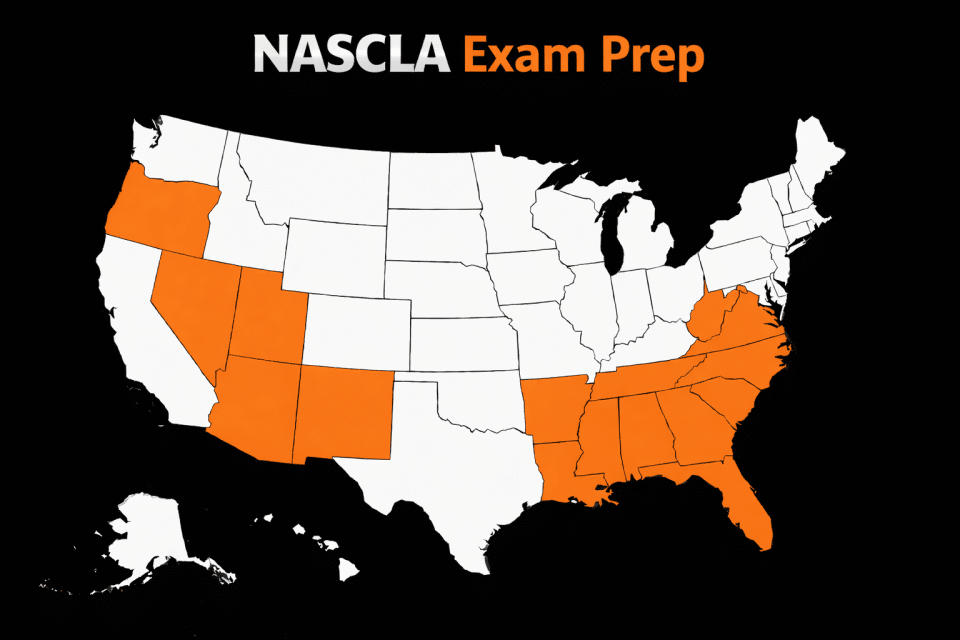
As of 2026, 16 states plus the U.S. Virgin Islands accept the NASCLA-accredited exam as a substitute for their state-specific general contractor trade examination:
| Alabama | Arizona | Arkansas |
| Florida | Georgia | Louisiana |
| Mississippi | Nevada | New Mexico |
| North Carolina | Oregon | South Carolina |
| Tennessee | Utah | Virginia |
| West Virginia | U.S. Virgin Islands |
Every accepting state still requires its own business and law exam after your NASCLA score is on file. A few states have additional requirements worth knowing before you schedule:
Arizona: Your NASCLA exam transcript must be dated within the past two years. If your score is older, you must retake the exam before Arizona will accept it — a rule that almost no other source documents clearly.
Florida: Accepts NASCLA in lieu of the trade exam, but also requires a separate Business & Finance exam and a Florida Building Code exam.
Louisiana: NASCLA is accepted for the trade portion, but the Louisiana Business and Law exam is always required regardless of your NASCLA score. Note that as of August 2025, Act 422 expanded roofing contractor licensing requirements—all roofing contractors now need a separate LSLBC license for any roofing work, regardless of project size.
Utah: No longer requires a trade exam at all, but will accept the NASCLA exam to satisfy a two-year experience requirement for general contractors.
Best NASCLA exam prep courses (2026)
The right NASCLA prep course does two things: it teaches the content across all 12 subject areas, and it trains you to navigate 24 reference books quickly under time pressure. Not every course does both well. Here is how the top options compare.
| Provider | Best for | Format | Pass guarantee | Price range | |
|---|---|---|---|---|---|
| AtHomePrep | Structured support, first-time passers | Online + live seminar | No Pass, No Pay | Check Pricing | See details ↓ |
| 1 Exam Prep | Self-study contractors on a budget | Online self-paced | Pass guarantee | Check Pricing | See details ↓ |
| MyContractorsLicense | Book-focused learners | Online + book set | Check the provider. | Check Pricing | See details ↓ |
AtHomePrep
Pros
- No Pass, No Pay guarantee
- Live seminar + online combo available
- Pre-tabbed books included in full packages
- 350,000+ students served
- Spanish-language options available
- Higher price than self-study options
Cons
- No Pass, No Pay guarantee
- Live seminar + online combo available
- Pre-tabbed books included in full packages
- 350,000+ students served
- Spanish-language options available
- Higher price than self-study options
Best for: Contractors who want structured guidance and the security of a live instructor, especially those who have failed a state exam before.
1 Exam Prep
Pros
- Lowest price in the market
- Strong tabbing and highlighting guides
- 24/7 access, self-paced
- Thousands of practice questions
- Book rental packages available
Cons
- No live instruction option
- Less hand-holding than AtHomePrep
Best for: Self-motivated contractors who have strong study habits and want to minimize course costs.
MyContractorsLicense.com
Pros
- Complete 24-book set available as a bundle
- Application process guidance included
- Clean, focused online platform
- Multi-state NASCLA coverage
Cons
- Smaller student community than AtHomePrep
- No live instruction option
Best for: Contractors who want the full 24-book set bundled with their course in one purchase.
Our recommendation: For most contractors taking the NASCLA exam for the first time—especially those licensing in multiple states simultaneously—AtHomePrep’s live seminar option is worth the additional cost. The pass rate difference between guided instruction and pure self-study is significant when the overall pass rate is only 60%.
What books do you need for the NASCLA exam?
The NASCLA exam is open book — all 24 reference books may be brought into the testing room. This is not an advantage unless you know how to use them under time pressure. A candidate who has never opened those books before exam day has no usable advantage over a closed-book test.
All 24 books may be pre-highlighted, tabbed with permanent tabs, and annotated. You cannot bring loose notes or supplements that are not part of the official reference set.
The 24-book set spans major subject areas including:
Building codes: International Building Code (IBC), International Residential Code (IRC)
Electrical: National Electrical Code (NEC)
Safety: OSHA standards for construction
Accessibility: ADA Standards for Accessible Design
Structural: BCSI Guide to Good Practice (truss bracing)
Business: Contractor law, contract management, project management references
Specialty: Concrete, masonry, mechanical, and additional trade references
Do not buy the 24 books individually. Assembly from separate sources takes significantly more time and increases the risk of purchasing incorrect editions. AtHomePrep and 1 Exam Prep both offer the complete set bundled with their prep courses — the books arrive pre-tabbed and highlighted, which alone saves 15 to 20 hours of preparation time.
How to apply for the NASCLA exam: step-by-step
The NASCLA application process runs through a separate system from the state licensing boards — most applicants miss this distinction and waste time applying in the wrong place. Here is the exact sequence:
Create an account at ned.nascla.org
The NASCLA National Examination Database (NED) is where your application lives — not the state licensing board. Go to ned.nascla.org, create an account, and begin your application.
Submit your application and pay the $65 fee
Complete the application with your experience documentation and pay the $65 application fee. NASCLA reviews your qualifications before approving you to sit for the exam.
Wait for NASCLA approval (up to 7 business days)
NASCLA will email you once approved. If your application is incomplete, they will detail what is missing. Applications are valid for one year from the approval date.
Schedule your exam at a PSI testing center ($130)
Once approved, you will receive a Candidate ID and instructions to schedule through PSI Services. Choose any PSI testing center that offers the NASCLA exam. The exam fee is $130, paid to PSI.
Prepare with your chosen prep course
You have three attempts to pass within one year of application approval. Do not schedule your exam before you have completed your prep course and practiced navigating all 24 reference books under timed conditions.
Pass the exam (70% = 81 correct out of 115)
Bring all 24 pre-tabbed reference books. The exam covers 12 subject areas. You need 81 correct answers to pass. Scores are reported immediately after the exam.
Apply to each state individually
Your NASCLA transcript is now on file. Apply to each state where you want a license, pass that state’s business and law exam, and submit the full state licensing application with insurance and bonding documentation.
Total upfront cost: $65 (NASCLA application) + $130 (PSI exam fee) + prep course ($200–$900 depending on provider and format) + book set if not included. Budget approximately $500–$1,100 all-in before state licensing fees.
Frequently asked questions
How many states accept the NASCLA exam?
As of 2026, 16 states plus the U.S. Virgin Islands accept the NASCLA accredited exam: Alabama, Arizona, Arkansas, Florida, Georgia, Louisiana, Mississippi, Nevada, New Mexico, North Carolina, Oregon, South Carolina, Tennessee, Utah, Virginia, and West Virginia. Each state still requires its own Business and Law exam after passing NASCLA — the exam only satisfies the trade exam portion of the licensing requirement.
What score do you need to pass the NASCLA exam?
You need a score of 70% to pass the NASCLA exam, which equals 81 correct answers out of 115 total questions. The exam covers 12 subject areas and is open book — you may bring all 24 required reference books, pre-tabbed and highlighted, into the testing room.
How much does the NASCLA exam cost?
The NASCLA exam costs $65 to apply (paid via ned.nascla.org) plus $130 for the exam at a PSI testing center — a total of approximately $195 in exam fees. With a prep course and the 24-book reference set, expect to budget $500 to $1,100 total before any state licensing fees.
How hard is the NASCLA exam?
The NASCLA exam has an approximate pass rate of 60%, which makes it genuinely challenging. Most failures are caused by poor book navigation under timed conditions rather than a lack of trade knowledge. The exam is open book, so knowing how to locate answers quickly across 24 reference texts is the critical skill — which is why enrolling in a prep course with pre-tabbing guidance significantly improves your odds.
Does passing the NASCLA exam give you a contractor license?
No. Passing the NASCLA exam satisfies only the trade exam requirement in accepting states. To become licensed, you must also pass each state’s Business and Law exam, submit a full state license application, provide proof of general liability insurance and bonding, and pay state-specific licensing fees. Florida additionally requires a separate Building Code exam.
Can specialty contractors use the NASCLA exam?
The standard NASCLA accredited exam is for commercial general building contractors only. Electrical, plumbing, HVAC, and other specialty trade contractors have separate licensing requirements. NASCLA does offer separate electrical exams (Master/Unlimited Electricians, Residential Wiremen, and Limited Energy Specialists), but these cover different states and are distinct from the general contractor exam.
How long does NASCLA certification last?
NASCLA exam results do not carry a fixed national expiration date, but individual states impose their own time limits on transcripts. Arizona requires your exam date to be within the past two years — one of the strictest state-level restrictions. To use your NASCLA results for reciprocity, you must maintain an active contractor license in at least one accepting state.
The NASCLA-accredited exam is the smartest move for any commercial general contractor planning to work in more than one state. One exam, passed once, satisfies the trade exam requirement in 16 states. But with a 60% pass rate, preparation is not optional—choosing the right course and learning to navigate 24 reference books under time pressure is what separates first-time passers from repeat test-takers. Here is everything you need to make that decision.
Related Articles:
Best Contractor License Schools (2026)
Be the first to know the best new courses


Courses4you.com helps students find quality test prep at affordable prices. Since 2017, we have compared courses, verified discount codes through live checkout testing, and published budget strategies across GMAT, GRE, SAT, and professional licensing preparation. Every offer listed on this site is tested before it goes live.